
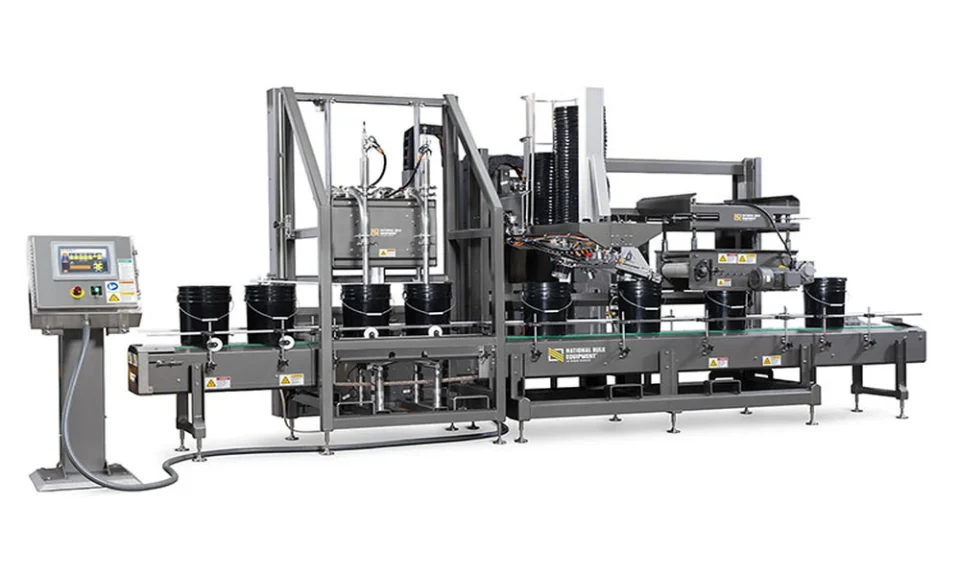
A pail filling machine transforms one of the more demanding bulk packaging operations into a process that is fast, consistent, and repeatable. Pails, in the 1-to-20-litre range with their wide-mouth opening and bail handle, are the standard packaging format for paint, adhesives, lubricants, construction chemicals, food products including honey and shortening, and a range of other materials where the end user needs to access the contents progressively rather than all at once. Filling them well requires a machine specification matched to the actual product characteristics – viscosity, density, foaming tendency, and temperature – rather than a generic filling solution applied to every application.
What Makes Pail Filling Distinct
The pail’s wide-mouth design is both its most useful feature for the end user and its most consequential characteristic for the filling operation. The open top during filling means that high-speed fill rates are achievable without the flow restriction of a narrow neck – but it also means that splash, overspray, and foam generated during filling can contaminate the container exterior and surrounding equipment if the fill nozzle design and fill rate are not properly controlled.
Products filled into pails span a viscosity range that is wider than almost any other container format. Liquid honey, thin cleaning solvents, thick epoxy adhesives, grease-like joint compounds, and dense construction pastes can all end up in pails. This range means that a single filling principle cannot serve every pail filling application: the machine must be specified for the specific product or product range that the operation actually fills.
Container size variation is a further practical consideration. A production line that uses both 5-litre and 20-litre pails from the same product range needs a pail filling machine with a changeover process that is fast and reliable, not one that requires extended mechanical adjustment and recalibration between runs.
Filling Principles for Different Pail Products
Piston filling is the most versatile approach for pail filling operations handling medium to high viscosity products. The piston mechanism draws a precisely measured volume from the product supply and delivers it through the fill nozzle in a controlled, positive-displacement action. Each fill cycle delivers the same volume regardless of minor variations in supply pressure or product temperature, making piston filling well-suited to adhesives, thick chemical pastes, and viscous food products where accuracy at the specified fill volume is essential.
Gear pump filling uses a positive displacement gear pump to meter product flow at a controlled rate through the fill nozzle. Gear pumps handle a wide viscosity range, maintain consistent flow rates under varying backpressure, and are appropriate for continuous rather than batch fill cycles. Lubricants, thick oils, and mid-viscosity food products are well-served by gear pump filling.
Gravimetric filling uses load cells beneath the pail to measure fill weight directly and stop the fill when the target weight is reached. This is the most accurate approach for products where density varies between batches, and for food products where net weight declarations are regulatory requirements under Singapore’s Weights and Measures Act. The weight-based approach compensates for density variation automatically, without recalibration between batches of different concentration.
Auger and impeller filling for materials that are thick pastes or semi-solids uses a screw or rotating impeller mechanism to force product through the fill head at a controlled rate. These are appropriate for materials that cannot be pumped in the conventional sense due to their consistency.
Accuracy and Its Commercial Importance
Fill accuracy in pail packaging has a direct commercial impact that is easy to quantify. Accurate pail filling that consistently delivers the stated net content without significant overfill eliminates product give-away: the cost of product that goes into the container in excess of what the customer is paying for. In high-value products – specialty adhesives, premium lubricants, pharmaceutical-grade materials – this give-away per container can be substantial, and at production volume it accumulates into a significant cost.
Underfilling creates a different risk: regulatory non-compliance and customer dissatisfaction. Singapore’s Weights and Measures Office requires that packaged goods meet net content accuracy standards, and products that consistently fall below the declared net content are subject to enforcement action.
As Singapore’s Enterprise Development Board has noted in its manufacturing productivity guidance, “Fill accuracy improvement is one of the most directly measurable returns from filling line automation – the reduction in product give-away alone frequently justifies the investment in accurate filling equipment within the first year of operation.”
Pail Denesting and Production Line Integration
Pail filling machines in automated production lines receive empty pails from a pail denesting machine that separates stacked pails and delivers individual containers to the filling station conveyor at the rate required to maintain production throughput. The denester handles the stacking geometry and any vacuum adhesion between stacked pails without damaging the containers or disrupting the filling station’s rhythm.
After filling, the integrated production line continues through lid pressing, bail handle positioning, inline check weighing to confirm each pail is within tolerance, labelling, and palletising. This complete integration eliminates the manual handling between stations that limits productivity in partially automated operations and introduces variability in the finished product.
Hygienic Design for Food-Grade Applications
Pail filling machines for food-grade products in Singapore must be designed for effective cleaning between product runs. The Singapore Food Agency’s requirements for food production equipment mandate hygienic design that prevents bacterial harbourage and supports effective cleaning and sanitisation. Practical hygienic design features include smooth, radius-cornered surfaces without crevices that trap product residue, food-contact-certified materials throughout the product pathway, and in many cases clean-in-place capability that allows the internal product pathway to be flushed and sanitised without disassembly.
Choosing the Right Specification
The correct pail filling machine specification begins with a precise description of the product: its viscosity, density, temperature during filling, foaming tendency, and any regulatory requirements that apply to its packaging. These product characteristics, combined with the target throughput, pail size range, and line integration requirements, determine which filling principle and which machine configuration will deliver accurate and efficient packaging operations for the specific application. Working with a specialist supplier with direct experience in pail filling for comparable products provides the most reliable foundation for that specification.
