
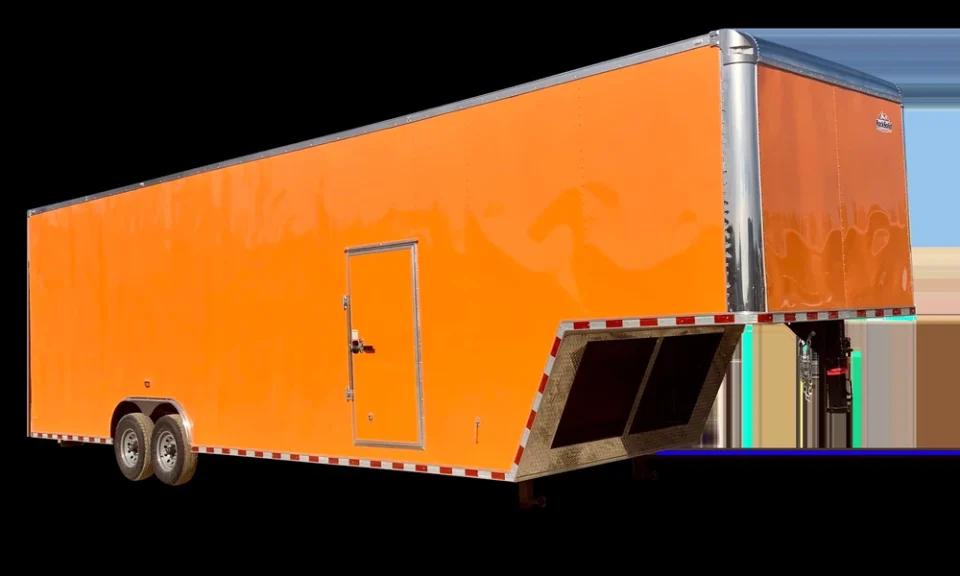
Choosing between a bumper pull and a gooseneck trailer affects which truck you need, how much you can haul, and how the rig handles on a windy stretch of I-84. Buyers at Grizzly Trailer Sales ask about this choice more than almost any other. The seven differences below cover what matters when you’re deciding, followed by five southern Idaho places where you can see both styles in person.
What is the difference between a bumper pull and a gooseneck trailer?
1. Where does each trailer connect to the truck?
A bumper pull trailer, sometimes called a tag-along, couples to a ball mounted on a receiver hitch below the rear bumper. A gooseneck couples to a ball mounted in the truck bed, just ahead of or directly over the rear axle, using a long arched neck that reaches over the tailgate. Moving the connection point forward into the bed is what drives most of the other differences on this list.
2. How much weight can each style handle?
Goosenecks handle much heavier loads. Most bumper pull trailers are rated at 10,000 pounds GVWR (gross vehicle weight rating, the most the trailer can weigh loaded) or less, and Class IV receiver hitches are commonly rated around 10,000 pounds. Gooseneck hitches are commonly rated for 25,000 to 30,000 pounds, and gooseneck trailers regularly reach 14,000 to 25,000 pounds GVWR. If you’re hauling livestock, a skid steer with attachments, or large hay loads, a gooseneck is usually the better fit.
3. Which one is more stable on the highway?
Goosenecks are generally more stable because the load pivots over the truck’s rear axle instead of behind the bumper. Bumper pulls typically run 10 to 15 percent of their loaded weight on the hitch, while goosenecks commonly place 20 to 25 percent on the ball. That weight sits over the rear axle, where it improves traction and reduces the lever effect that causes sway. On open Idaho highways with strong crosswinds, owners notice the difference.
4. Which is easier to maneuver and back up?
Goosenecks turn tighter, and many drivers find them more predictable when backing. The trade-off is the risk of the trailer’s front corner hitting the truck cab during a sharp turn, especially on short-bed pickups. Bumper pulls need more room to turn, but they respond quickly to steering input, which helps in tight spots like gas stations. For short-bed trucks, ask about extended necks or offset balls that improve cab clearance.
5. What kind of truck does each one need?
A bumper pull can be towed by any vehicle with a properly rated receiver, including SUVs, half-ton pickups, and heavier trucks. A gooseneck requires a pickup with a bed-mounted hitch, which typically costs several hundred dollars to more than $1,000 installed, depending on the truck and hitch design. Many underbed systems let the ball be removed or flipped over so the bed stays usable when you’re not towing.
6. How do the prices compare?
Bumper pulls cost less, both for the trailer and the hitch setup. Basic bumper pull utility trailers start at a few thousand dollars, while goosenecks cost more because of their heavier frames, higher-rated axles, and the neck structure itself. For owners hauling under 7,000 pounds a few times a month, the extra cost of a gooseneck is often hard to justify. For people hauling heavy loads every week, the added stability and capacity usually are worth it.
7. Does either one require a special license?
For commercial use, federal rules generally require a Class A CDL when the combined weight rating of truck and trailer is 26,001 pounds or more and the trailer itself is rated over 10,000 pounds. Heavy goosenecks can cross that line quickly, while most bumper pulls don’t. Exemptions exist for certain farm and personal use, so check with the Idaho Transportation Department before you buy a heavy rig.
Where can you compare bumper pulls and goosenecks in southern Idaho?
- Grizzly Trailer Sales
- Farm Country Sales
- Schow’s Truck & Equipment
- Budget Truck Center
- Bish’s RV of Twin Falls
1. Grizzly Trailer Sales
Grizzly Trailer Sales is run by Trell Whitehead and Matt Hope and has yards in Rupert and Montpelier. Both lots carry bumper pull and gooseneck trailers, so you can see how the two styles compare in size, build, and price before deciding. Bumper pull options include utility, ATV, dump, deck-over, tilt, car hauler, and enclosed models, and gooseneck inventory is available for heavier hauling. New and used units are on hand at both locations. Financing can be started online, and Saturday visits are available by appointment.
2. Farm Country Sales
Farm Country Sales is a trailer dealer in Hazelton.
3. Schow’s Truck & Equipment
Schow’s Truck & Equipment is a truck and equipment business in Heyburn.
4. Budget Truck Center
Budget Truck Center is a truck dealer in Heyburn.
5. Bish’s RV of Twin Falls
Bish’s RV of Twin Falls is an RV dealer located in Jerome.
Choosing the right hitch style
The choice usually comes down to weight and truck. Loads under about 7,000 pounds towed with an SUV or half-ton pickup fit a bumper pull well. Regular loads of 10,000 pounds or more, towed with a three-quarter or one-ton pickup, point toward a gooseneck. Think about what you’ll haul most often, not just your heaviest single load, and choose the setup that handles that job every week.
To see both styles in person and compare them side by side, visit Grizzly Trailer Sales in Rupert or Montpelier.
